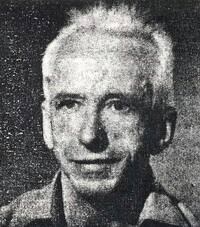
James, an American with
Irish origin, was born in
New York. He joined the Society of Jesus
when he was 19. In 1937, when he heard the call of Father Ledochowski, Head of
the Society, for the need of volunteers to work in Arab and Islamic countries,
he presented himself for the mission. He came to
Lebanon
and started learning Arabic in Bikfaya (1938-1940) and in
Aleppo (1940-1941). He remained in the Near
East and learned theology in
Beirut
where he was ordained a priest (1944). After teaching a course on Islamic
institutions in the Oriental Institute in
Rome
for three years, he came back for good to
Beirut
to teach philosophy. We still remember him in his first years of teaching at
university because he used to come to school from time to time in 1950, when we
were still students in the first part of the baccalaureate. He used to follow
with us an Arabic literature course given by the encyclopedic scholar Pr. Fouad
Aphram al-Boustany. Father Finnegan would quietly sit in a back seat and we
would look at him with respect whispering, “The Orientalist has arrived”. We would
put an end to our pranks that were not too many anyway because of the great
respect and love we had in our hearts for our teacher.
Father Finnegan was a
specialist in Greek philosophy and history. After his death, a book that he
wrote in Arabic based on some of his research was published. He taught Greek
philosophy in addition to classic philosophy and Arab philosophers in the Saint
Joseph University (1947-1978), the Université Saint-Esprit de Kaslik (Holy
Spirit University of Kaslik – Lebanon), the Lebanese University, and the
Institute of Saint Paul in Harissa (Lebanon). When the Jesuit scholar Maurice
Bouyges died in 1951, after achieving his unique work, i.e. the publication of The
Commentary on Metaphysics by Averroes in thick volumes one after the other,
Father Finnegan decided to verify the manuscript of the introduction left by
Bouyges with the linguistic scholar Father Fleisch.
Even if Father Finnegan
was very much taken by research and teaching, he was very close to people in
general and to his students in particular. He was kind, had a great sense of
humor and helped as much as he could. On the night of February 26, 1984, as he was
going from his residence to the
Hôtel-Dieu
Hospital to celebrate
mass, careless of the danger of the bombs that attacked residential areas from
time to time, he was hit by one of them in the middle of the street. He died as
a martyr to a cause and to love.
Father Finnigan, as an
American, could have left
Lebanon
during the war, yet he kept the
promise he took and never left the ship that was battling through the storm and
the dangers he was aware of. He said in a letter he wrote to his sister a short
while before he died, “
Lebanon
became my country, just as the
United States
became my father’s country after emigrating from
Ireland
”.
Father Finnigan left his
father, mother and country to serve mankind in the Arab Orient and he died for
his new country. This is the greatest love!
